

This is another common point of confusion, similar to Zigbee vs. mesh—but this time with two technologies that are designed to work together.
The simplest way to put it is:
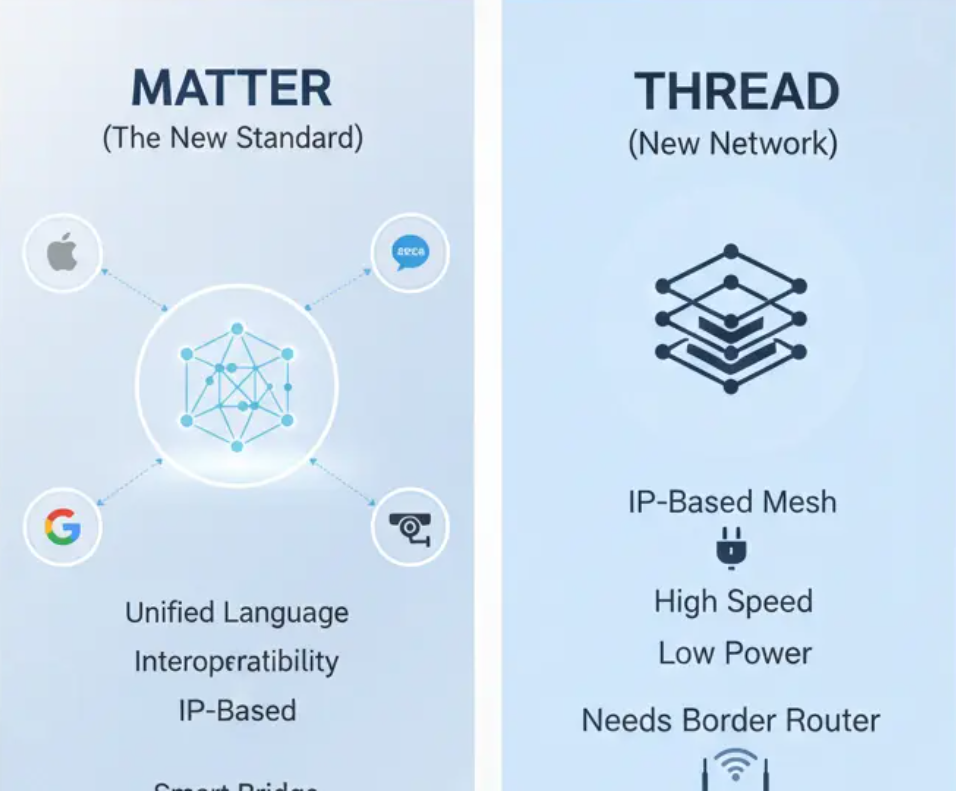
Matter is the language, Thread is the network that carries that language.
1. The Core Distinction
Matter is an application layer standard. It defines how devices talk to each other, how they are controlled, and how they expose their functions (e.g., a light bulb’s on/off state) regardless of the underlying network.
Thread is a network layer protocol. It defines how devices connect to each other, how they form a low-power mesh network, and how they route IP packets.
A Matter device can run over Thread, WiFi, or Ethernet—but Thread is specifically designed to be the low-power, mesh-capable transport for Matter.
2. What is Matter?
Matter is a unified, royalty-free connectivity standard backed by the Connectivity Standards Alliance (CSA). Its goal is to make smart home devices work seamlessly across brands (Apple, Google, Amazon, Samsung, etc.).
Role: Application layer (the “language”).
What it does:
Defines device types (light, door lock, thermostat, etc.) and their commands.
Ensures that a Matter-certified light switch from any brand can control a Matter-certified light bulb from any brand, as long as they are on the same network.
Underlying transports: Works over WiFi, Thread, and Ethernet. (Bluetooth is only used for commissioning, not ongoing control.)
3. What is Thread?
Thread is an IPv6-based, low-power, mesh networking protocol. It was developed by the Thread Group and is designed specifically for IoT devices.
Role: Network layer (the “transport”).
What it does:
Creates a self-healing mesh network where battery-powered devices can communicate.
Each device gets an IPv6 address, so it can speak directly to other devices and the internet without proprietary hubs (if a Thread Border Router is present).
Key features:
Low power consumption (ideal for sensors, locks, switches).
No single point of failure (mesh routing).
Uses the same 2.4 GHz radio frequency as WiFi and Zigbee.
4. How They Work Together
In a typical setup:
Thread provides the mesh network infrastructure.
Matter runs on top of Thread (or WiFi) to provide interoperability and a common control layer.
| Component | Example |
| Thread network | A collection of smart locks, light bulbs, and sensors that talk to each other wirelessly in a mesh. |
| Thread Border Router | A device (like an Apple HomePod, Google Nest Hub, or Amazon Eero) that connects the Thread network to your home WiFi and the internet. |
| Matter | The common language so that an Apple Home app, Google Assistant, and a physical switch from a third party can all control the same Thread based light bulb. |
5. Key Differences at a Glance
| Feature | Matter | Thread |
| Layer | Application layer (data & control) | Network layer (IP routing & mesh) |
| What it defines | Device types, commands, security at the app level | How packets move between devices, network formation |
| Underlying radio | None; runs over Wi Fi, Thread, or Ethernet | IEEE 802.15.4 (2.4 GHz radio) |
| Primary purpose | Interoperability across ecosystems | Reliable, low-power IP mesh |
| Ownership | Connectivity Standards Alliance (CSA) | Thread Group |
6. Common Misunderstandings
“Does Matter require Thread?”
No. Matter works over WiFi and Ethernet as well. Thread is an optional, but highly complementary, transport for low power, battery-operated devices.
“Is Thread just the new Zigbee?”
Not exactly. Zigbee is a full protocol stack (application + network). Thread is only the network layer, leaving the application layer to Matter or other protocols. In fact, many future Thread devices will use Matter as their application layer.
“Can a Matter over Thread device talk to a Zigbee device?”
Not directly. They use different network layers (802.15.4 with different stacks). However, some border routers (like the Amazon Echo Hub or HomePod) can bridge between Zigbee and Matter, making them appear as a single unified system to the user.
Summary
If you’re building a smart home today:
Matter ensures you aren’t locked into one brand’s ecosystem—your Apple Home, Google Home, and Alexa can all control the same device.
Thread provides the robust, low-power mesh that makes battery-operated Matter devices (like door locks and motion sensors) reliable without needing a dedicated proprietary hub.
Together, Matter + Thread form the foundation of the next generation of interoperable, hub-less smart homes.
Post time: Apr-25-2026


